Human Rights Quarterly (Samantha Lakin)
Reviewer: Samantha LakinDate Published: Feb/2017
Source: Human Rights Quarterly, Volume 39, Number 1, February 2017, pp. 257-260.
Text:
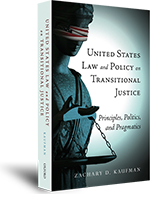
Zachary D. Kaufman, United States Law and Policy on Transitional Justice: Principles, Politics, and Pragmatics (Oxford University Press). ISBN 9780190243494, 383 pages.
In his new book United States Law and Policy on Transitional Justice: Principles, Politics, and Pragmatics, Zachary D. Kaufman establishes a novel framework to explain how and why the United States government (USG) has made decisions in the aftermath of mass atrocities. His framework is based as much on politics and pragmatics as it is on legal tradition and commitment to norms. In his introduction, Kaufman outlines his central research questions, which he addresses through relevant case studies throughout the book. The book centers around two such questions: (1) Why did the USG support particular transitional justice (TJ) options in the immediate aftermaths of World War II and the Cold War? and (2) What theoretical framework best explains USG policy on TJ? In addressing these two questions, Kaufman introduces his new theory, “prudentialism,” which contrasts with the theory of “legalism” that Gary Bass presents in his book, Stay the Hand of Vengeance: The Politics of War Crimes Tribunals.
In his first three chapters, Kaufman outlines the different policy options that the USG has considered and taken in the aftermath of genocide and other mass atrocities, and he argues how these policy decisions stem from prudentialism rather than legalism. Kaufman defines his theory of prudentialism as based in realism by focusing on the relationship between three factors: normative beliefs, politics, and pragmatics. Kaufman describes Bass’ contrasting legalism theory as grounded in a liberal and normative commitment to due process and other legalistic principles and traditions. By introducing prudentialism as a case-specific balance of normative beliefs, politics, and pragmatics, Kaufman challenges the legalistic proposition that liberal states will generally choose to prosecute perpetrators of atrocity crimes. Kaufman therefore introduces greater—and more accurate—nuance to our understanding of policy decisions during and after atrocity crimes. His theory is compelling, for without completely discarding the influence of normative values of liberal states, Kaufman demonstrates through his case studies that politics and pragmatics matter at least as much when states make TJ decisions.
Kaufman chooses a case study approach to test and compare prudentialism and legalism. The cases Kaufman chooses are Nazi Germany and Imperial Japan; the bombing of Pan Am flight 103 over Lockerbie, Scotland; the 1990 to 1991 Iraqi offenses against Kuwaitis; the atrocities in the Balkans in the 1990s; and the Genocide against the Tutsi in Rwanda in 1994. In his discussion of these six cases, Kaufman impressively uses an enormous amount of primary source data, including hundreds of previously classified USG documents he obtained and elite interviews conducted with key decision-makers. His meticulous research and sophisticated analysis of these cases reveal that, instead of consistently supporting prosecutorial TJ mechanisms, as legalism would suggest, the USG considered and implemented a range of TJ options—legalistic and not. Kaufman thus demonstrates the confluence of norms, politics, and pragmatics driving USG policymaking on TJ.
For example, in the case of atrocities committed by Japan during World War II, the USG implemented amnesty and lustration as TJ options in addition to prosecution. Kaufman describes the prominent role the USG played in the Tokyo Tribunal, serving as the most prominent convener of discussions on creating the court, producing the initial draft of the tribunal’s charter, dominating the prosecution team, assisting the defendants, and presiding over the trials. Based on his new theory of prudentialism, Kaufman offers the following explanations for this central US involvement. First, the US was highly sensitive to the fact that Americans suffered at the hands of the Japanese during the war, as the Japanese abused American POWs and attacked the US itself at Pearl Harbor. In addition to retrospective concerns, the US wished to assert its presence in Asia, where American and Soviet spheres of influence were emerging at a time when the US sought to stem the spread of communism. Finally, racism likely also drove American decision-making.
Alongside the Tokyo Tribunal, the USG provided amnesty to alleged Japanese atrocity perpetrators, which will be surprising to many scholars and lay readers alike. First, the USG granted full amnesty to Emperor Hirohito in order to maintain peace in Japan, as his indictment would likely have prompted civil unrest, and also to keep him as an ally in Asia. Even more surprising, the USG granted amnesty to thousands of Japanese doctors, scientists, and officials who were involved in medical experiments on humans. Like with Emperor Hirohito, this amnesty was politically motivated in that the USG sought the data from these ghastly experiments. According to Kaufman, the example of Japan therefore shows how prudentialism more accurately accounts for the USG’s decision to pursue non-legalistic TJ options in addition to trials when dealing with certain atrocity perpetrators.
Kaufman’s discussion of the USG’s TJ response in the aftermath of the 1994 genocide in Rwanda also highlights his theory of prudentialism. According to Kaufman, the USG did not view any TJ system in Rwanda as a pragmatic threat, especially as the UN International Criminal Tribunal for Rwanda (ICTR) met the USG’s goals of deterrence and promoting justice. The USG was convinced that its involvement in the ICTR would ensure the best outcome, and it therefore took another leading role, as it had done in Japan. Certain US officials believed that only the USG had the necessary resources, will, and mature judicial traditions to guide the ICTR. In addition, US officials believed that had the USG not acted in creating the ICTR, it would have faced criticism of being racist and regionalist, especially after the USG had pursued tribunals for Nazi Germany, Imperial Japan, and the Balkans. In the case of Rwanda, the USG’s commitment to a prosecutorial mechanism might seem like legalism, but, as Kaufman shows, this decision was not only normative in nature; rather, the USG considered the political and practical situation in Rwanda (and beyond) before establishing the ICTR. What seems like an obvious case of legalism can, in fact, be better explained by Kaufman’s theory of prudentialism.
Kaufman’s book acknowledges that some normative perspective existed in each of the six cases in the books. Specifically, the USG believed that at least some atrocity perpetrators should be prosecuted and punished for their offenses. However, in three of the four cases (Germany, Japan, and the Balkans) the USG supported the creation of non-legalistic TJ options (amnesty and lustration) alongside trials. Kaufman thus concludes that, unlike legalism, prudentialism correctly accounts for the USG’s security interests and other political and practical considerations.
United States Law and Policy on Transitional Justice presents a helpful framework to analyze government responses to atrocities. In doing so, the book describes and explains how the United States—and other states, whether liberal or illiberal—may choose from a range of TJ options, from the legalistic and normative tradition of prosecution to inaction, lustration, amnesty, exile, indefinite detention, and even lethal force. Kaufman’s prudentialism framework is an essential new tool of analysis for scholars and practitioners of TJ specifically, and international relations generally, to understand why states support certain options in the aftermath of mass atrocities. In an increasingly globalized, messy world with ongoing questions of how states should and do respond to humanitarian crises, prudentialism offers a framework to make sense of these complicated policy decisions while realistically considering governmental perspectives as well as the costs and benefits of state action.
Samantha Lakin
Endnotes
Samantha Lakin is a Ph.D. student at The Strassler Center for Holocaust and Genocide Studies, Clark University, USA. Lakin was a Fulbright scholar in Switzerland, where she researched the rescue of Jewish children to Switzerland during World War II. She has worked in Rwanda, Northern Uganda, and Burundi for the past four years, researching local perspectives of symbolic justice in the aftermath of the 1994 genocide in Rwanda—memorialization, commemoration, and personal memory practice.
TomsBooks (Thomas H. Peebles)
Reviewer: Thomas H. PeeblesDate Published: Feb/2017
Source: TomsBooks
Text:
“Do Something”
Zachary Kaufman, United States Law and Policy on Transitional Justice: Principles, Politics, and Pragmatics
The term “transitional justice” is applied most frequently to “post conflict” situations, where a nation state or region is emerging from some type of war or violent conflict that has given rise to genocide, war crimes, or crimes against humanity — each now a recognized concept under international law, with “mass atrocities” being a common shorthand used to embrace these and related concepts. In United States Law and Policy on Transitional Justice: Principles, Politics, and Pragmatics, Zachary Kaufman, a Senior Fellow and expert on human rights at Harvard University’s Kennedy School of Government, explores the circumstances which have led the United States to support that portion of the transitional justice process that determines how to deal with suspected perpetrators of mass atrocities, and why it chooses a particular means of support (disclosure: Kaufman and I worked together in the US Department of Justice’s overseas assistance unit between 2000 and 2002, although we had different portfolios: Kaufman’s involved Africa and the Middle East, while I handled Central and Eastern Europe).
Kaufman’s book, adapted from his Oxford University PhD dissertation, centers around case studies of the United States’ role in four major transitional justice situations: Germany and Japan after World War II, and ex-Yugoslavia and Rwanda in the 1990s, after the end of the Cold War. It also looks more briefly at two secondary cases, the 1988 bombing of Pan American flight 103, attributed to Libyan nationals, and atrocities committed during Iraq’s 1990-91 occupation of Kuwait. Making extensive use of internal US government documents, many of which have been declassified, Kaufman digs deeply into the thought processes that informed the United States’ decisions on transnational justice in these six post-conflict situations. Kaufman brings a social science perspective to his work, attempting to tease of out of the case studies general rules about how the United States might act in future transitional justice situations.
The term “transitional justice” implicitly affirms that a permanent and independent national justice system can and should be created or restored in the post-conflict state. Kaufman notes at one point that dealing with suspected perpetrators of mass atrocities is just one of several critical tasks involved in creating or restoring a permanent national justice system in a post-conflict state. Others can include: building or rebuilding sustainable judicial institutions, strengthening the post-conflict state’s legislation, improving capacity of its justice-sector personnel, and creating or upgrading the physical infrastructure needed for a functioning justice system. These latter tasks are not the focus of Kaufman’s work. Moreover, in determining how to deal with alleged perpetrators of mass atrocities, Kaufman’s focus is on the front end of the process: how and why the United States determined to support this portion of the process generally and why it chose particular mechanisms rather than others. The outcomes that the mechanisms produce, although mentioned briefly, are not his focus either.
In each of the four primary cases, the United States joined other nations to prosecuted those accused or suspected of involvement in mass atrocities before an international criminal tribunal, which Kaufman characterizes as the “most significant type of transitional justice institution” (p.12). Prosecution before an international tribunal, he notes, can promote stability, the rule of law and accountability, and can serve as a deterrent to future atrocities. But the process can be both slow and expensive, with significant political and legal risks. Kaufman’s work provides a useful reminder that prosecution by an international tribunal is far from the only option available to deal with alleged perpetrators of mass atrocities. Others include trials in other jurisdictions, including those of the post-conflict state, and several non-judicial alternatives: amnesty for those suspected of committing mass atrocities, with or without conditions; “lustration,” where suspected persons are disenfranchised from specific aspects of civic life (e.g., declared ineligible for the civil service or the military); and “doing nothing,” which Kaufman considers tantamount to unconditional amnesty. Finally, there is the option of summary execution or other punishment, without benefit of trial. These options can be applied in combination, e.g., amnesty for some, trial for others.
Kaufman weighs two models, “legalism” and “prudentialism,” as potential explanations for why and how the United States acted in the cases under study and is likely to act in the future. Legalism contends that prosecution before an international tribunal of individuals suspected or accused of mass atrocities is the only option a liberal democratic state may elect, consistent with its adherence to the rule of law. In limited cases, amnesty or lustrations may be justified as a supplement to initiating cases before a tribunal. Summary execution may never be justified. Prudentialism is more ad hoc and flexible,with the question whether to establish or invoke an international criminal tribunal or pursue other options determined by any number of different political, pragmatic and normative considerations, including such geo-political factors as promotion of stability in the post-conflict state and region, the determining state or states’ own national security interests, and the relationships between determining states. Almost by definition, legalism precludes consideration of these factors.
Kaufman presents his cases in a highly systematic manner, with tight overall organization. An introduction and three initial chapters set forth the conceptual framework for the subsequent case studies, addressing matters like methodology and definitional parameters. The four major cases are then treated in four separate chapters, each with its own introduction and conclusion, followed by an overall conclusion, also with its own introduction and conclusion (the two secondary cases, Libya and Iraq are treated within the chapter on ex-Yugoslavia). Substantive headings throughout each chapter make his arguments easy to follow. General readers may find jarring his extensive use of acronyms throughout the text, drawn from a three-page list contained at the outset. But amidst Kaufman’s deeply analytical exploration of the thinking that lay behind the United States’ actions, readers will appreciate his decidedly non-sociological hypothesis as to why the United States elects to engage in the transitional justice process: a deeply felt American need in the wake of mass atrocities to “do something” (always in quotation marks).
* * *
Kaufman begins his case studies with the best-known example of transitional justice, Nazi Germany after World War II. The United States supported creation of what has come to be known as the Nuremberg War Crimes tribunal, a military court administered by the four victorious allies, the United States, Soviet Union, Great Britain and France. The Nuremberg story is so well known, thanks in part to “Judgment at Nuremberg,” the best-selling book and popular film, that most readers will assume that the multi-lateral Nuremberg trials were the only option seriously under consideration at the time. To the contrary, Kaufman demonstrates that such trials were far from the only option on the table.
For a while the United States seriously considered summary executions of accused Nazi leaders. British Prime Minister Winston Churchill pushed this option during wartime deliberations and, Kaufman indicates, President Roosevelt seemed at times on the cusp of agreeing to it. Equally surprisingly, Soviet Union leader Joseph Stalin lobbied early and hard for a trial process rather than summary executions. The Nuremberg Tribunal “might not have been created without Stalin’s early, constant, and forceful lobbying” (p.89), Kaufman contends. Roosevelt abandoned his preference for summary executions after economic aspects of the Morgenthau Plan, which involved the “pastoralization” of Germany, were leaked to the press. When the American public “expressed its outrage at treating Germany so harshly through a form of economic sanctions,” Roosevelt concluded that Americans would be “unsupportive of severe treatment for the Germans through summary execution” (p.85).
But the United States’ support for war crimes trials became unwavering only after Roosevelt died in April 1945 and Harry S. Truman assumed the presidency. The details and mechanics of a multi-lateral trial process were not worked out until early August 1945 in the “London Agreement,” after Churchill had been voted out of office and Labor Prime Minister Clement Atlee represented Britain. Trials against 22 high level Nazi officials began in November 1945, with verdicts rendered in October 1946: twelve defendants were sentenced to death, seven drew prison sentences, and three were acquitted.
Many lower level Nazi officials were tried in unilateral prosecutions by one of the allied powers. Lustration, barring active Nazi party members from major public and private positions, was applied in the US, British, and Soviet sectors. Numerous high level Nazi officials were allowed to emigrate to the United States to assist in Cold War endeavors, which Kaufman characterizes as a “conditional amnesty” (Nazi war criminals who emigrated to the United States is the subject of Eric Lichtblau’s The Nazis Next Door: How America Became a Safe Haven for Hitler’s Men, reviewed here in October 2015; Frederick Taylor’s Exorcising Hitler: The Occupation and Denazification of Germany, reviewed here in December 2012, addresses more generally the manner in which the Allies dealt with lower level Nazi officials). By 1949, the Cold War between the Soviet Union and the West undermined the allies’ appetite for prosecution, with the Korean War completing the process of diverting the world’s attention away from Nazi war criminals.
The story behind creation of the International Military Tribunal for the Far East, designed to hold accountable accused Japanese perpetrators of mass atrocities, is far less known than that of Nuremberg, Kaufman observes. What has come to be known as the “Tokyo Tribunal” largely followed the Nuremberg model, with some modifications. Even though 11 allies were involved, the United States was closer to the sole decision-maker on the options to pursue in Japan than it had been in Germany. As the lead occupier of post-war Japan, the United States had “no choice but to ‘do something’” (p.119). Only the United States had both the means and will to oversee the post-conflict occupation and administration of Japan. That oversight authority was vested largely in a single individual, General Douglas MacArthur, Supreme Commander of the Allied forces, whose extraordinarily broad – nearly dictatorial — authority in post World War II Japan extended to the transitional justice process. MacArthur approved appointments to the tribunal, signed off on its indictments, and exercised review authority over its decisions.
In the interest of securing the stability of post-war Japan, the United States accorded unconditional amnesty to Japan’s Emperor Hirohito. The Tokyo Tribunal indicted twenty-eight high-level Japanese officials, but more than fifty were not indicted, and thus also benefited from an unconditional amnesty. This included many suspected of “direct involvement in some of the most horrific crimes of WWII” (p.108), several of whom eventually returned to Japanese politics. Through lustration, more than 200,000 Japanese were removed or barred from public office, either permanently or temporarily. As in Germany, by the late 1940s the emerging Cold War with the Soviet Union had chilled the United States’ enthusiasm for prosecuting Japanese suspected of war crimes.
The next major United States engagements in transitional justice arose in the 1990s, when the former Yugoslavia collapsed and the country lapsed into a spasm of ethnic violence; and massive ethnic-based genocide erupted in Rwanda in 1994. By this time, the Soviet Union had itself collapsed and the Cold War was over. In both instances, heavy United States’ involvement in the post-conflict process was attributed in part to a sense of remorse for its lack of involvement in the conflicts themselves and its failure to halt the ethnic violence, resulting in a need to “do something.” Rwanda marks the only instance among the four primary cases where mass atrocities arose out of an internal conflict.
The ethnic conflicts in Yugoslavia led to the creation of the International Criminal Tribunal for Yugoslavia (ICTY), based in The Hague and administered under the auspices of the United Nations Security Council. Kaufman provides much useful insight into the thinking behind the United States’ support for the creation of the court and the decision to base it in The Hague as an authorized Security Council institution. His documentation shows that United States officials consistently invoked the Nuremberg experience. The United States supported a multi-lateral tribunal through the Security Council because the council could “obligate all states to honor its mandates, which would be critical to the tribunal’s success” (p.157). The United States saw the ICTY as critical in laying a foundation for regional peace and facilitating reconciliation among competing factions. But it also supported the ICTY and took a lead role in its design to “prevent it from becoming a permanent [tribunal] with global reach” (p.158), which it deemed “potentially problematic” (p.157).
The United States’ willingness to involve itself in the post-conflict transitional process in Rwanda, even more than in the ex-Yugoslavia, may be attributed to its failure to intervene during the worst moments of the genocide itself. That the United States “did not send troops or other assistance to Rwanda perversely may have increased the likelihood of involvement in the immediate aftermath,” Kaufman writes. A “desire to compensate for its foreign policy failures in Rwanda, if not also feelings of guilt over not intervening, apparently motivated at least some [US] officials to support a transitional justice institution for Rwanda” (p.197).
Once the Rwandan civil war subsided, there was a strong consensus within the international community that some kind of international tribunal was needed to impose accountability upon the most egregious génocidaires; that any such tribunal should operate under the auspices of the United Nations Security Council; that the tribunal should in some sense be modeled after the ICTY; and that the United States shouldtake the lead in establishing the tribunal. The ICTY precedent prompted US officials to “consider carefully the consistency with which they applied transitional justice solutions in different regions; they wanted the international community to view [the US] as treating Africans similarly to Europeans” (p.182). According to these officials, after the precedent of proactive United States involvement in the “arguably less egregious Balkans crisis,” the United States would have found it “politically difficult to justify inaction in post-genocide Rwanda” (p.182).
The United States favored a tribunal modeled after and structurally similar to the ICTY, which came to be known as International Criminal Tribunal for Rwanda (ICTR). The ICTR was the first international court having competence to “prosecute and punish individuals for egregious crimes committed during an internal conflict” (p.174), a watershed development in international law and transitional justice. To deal with lower level génocidaires, the Rwandan government and the international community later instituted additional prosecutorial measures, including prosecutions by Rwandan domestic courts and local domestic councils, termed gacaca.
No international tribunals were created in the two secondary cases, Libya after the 1998 Pan Am flight 103 bombing, and the 1990-91 Iraqi invasion of Kuwait. At the time of the Pam Am bombing, several years prior to the September 11, 2001 attacks, United States officials considered terrorism a matter to be addressed “exclusively in domestic contexts” (p.156). In the case of the bombing of Pan Am 103, where Americans had been killed, competent courts were available in the United States and the United Kingdom. There were numerous documented cases of Iraqi atrocities against Kuwaiti civilians committed during Iraq’s 1990-91 invasion of Kuwait. But the 1991 Gulf War, while driving Iraq out of Kuwait, otherwise left Iraqi leader Saddam Hussein in power. The United States was therefore not in a position to impose accountability upon Iraqis for atrocities committed in Kuwait, as it had done after defeating Germany and Japan in World War II.
* * *
In evaluating the prudentialism and legalism models as ways to explain the United States’ actions in the four primary cases, prudentialism emerges as a clear winner. Kaufman convincingly demonstrates that the United States in each was open to multiple options and motivated by geo-political and other non-legal considerations. Indeed, it is difficult to imagine that the United States – or any other state for that matter — would ever, in advance, agree to disregard such considerations, as the legalism model seems to demand. After reflecting upon Kaufman’s analysis, I concluded that legalism might best be understood as more aspirational than empirical, a forward-looking, prescriptive model as to how the United States should act in future transitional justice situations, favored in particular by human rights organizations.
But Kaufman also shows that the United States’ approach in each of the four cases was not entirely an ad hoc weighing of geo-political and related considerations. Critical to his analysis are the threads which link the four cases, what he terms “path dependency,” whereby the Nuremberg trial process for Nazi war criminals served as a powerful influence upon the process set up for their Japanese counterparts; the combined Nuremberg-Tokyo experience weighed heavily in the creation of ICTY; and ICTY strongly influenced the structure and procedure of ICTR. This cumulative experience constitutes another factor in explaining why the United States in the end opted for international criminal tribunals in each of the four cases.
If a general rule can be extracted from Kaufman’s four primary cases, it might therefore be that an international criminal tribunal has evolved into the “default option” for the United States in transitional justice situations, showing the strong pull of the only option which the legalism model considers consistent with the rule of law. But these precedents may exert less hold on US policy makers going forward, as an incoming administration reconsiders the United States’ role in the 21st century global order. Or, to use Kaufman’s apt phrase, there may be less need felt for the United States to “do something” in the wake of future mass atrocities.
Thomas H. Peebles
Venice, Italy
February 10, 2017
Journal of International Criminal Justice (Jonathan Beloff)
Reviewer: Jonathan BeloffDate Published: Dec/2016
Source: Journal of International Criminal Justice (Vol. 14, No. 5)
Text:
Scholarship on transitional justice and international relations rarely intersect, as they appear to be considered part of distinct fields within the social sciences. Traditionally, the two are only brought together when international relations assists in illustrating a specific argument in transitional justice.
Scant academic literature focuses on the direct relationship between the two subjects. This dearth of scholarship leads to a gap in the discussion of how states view and enact transitional justice as part of their foreign policies. Since the end of the Second World War, many states’ foreign policies have contained increasing elements of transitional justice. This increase in transitional justice usage requires a better understanding — especially with recent withdrawals by world powers from participation in armed conflict — of how transitional justice plays a role in international relations and foreign policymaking. In United States Law and Policy on Transitional Justice: Principles, Politics, and Pragmatics, Zachary Kaufman, a Senior Fellow at Harvard University’s John F. Kennedy School of Government, adds to this literature by analysing foreign policy of the United States on supposed past commitments to enforce justice during and after conflict. Kaufman identifies international relations and transitional justice as components of how the United States reacts to crises such as genocide, human rights violations and terrorism.
One of the few other books on the relationship between transitional justice and foreign affairs is by Gary Bass.1 Bass draws upon liberal international relations theory to explain how transitional justice is part of a state’s foreign relations. Despite being well structured and widely known, his argument of ‘legalism’ lacks credibility for international relation theorists who do not view liberalism as a compelling explanation of foreign policymaking. In comparison, Kaufman’s theory of ‘prudentialism’ builds on the assumptions of realism. Through prudentialism, Kaufman focuses on how leaders make decisions about whether and, if so, how to implement transitional justice in order to promote state interests. Central to his work, Kaufman observes that transitional justice is not guaranteed after conflicts. Rather, Kaufman finds, transitional justice is performed only when the appropriate conditions of promoting state interests (such as security) pertain. Kaufman’s work thus directly challenges Bass’ claims about liberal states’ commitment to the rule of law.
To test his theory, Kaufman analyses US decision-making through semi-structured elite interviews and previously classified documents he obtained from the Department of State. Both sources of information are unique and invaluable. Through presenting and assessing this treasure trove of fascinating information, Kaufman shows the processes by which the US government pragmatically decides whether and how to implement transitional justice mechanisms in response to atrocities. He clearly organizes his transitional justice typology into seven categories of options: inaction; lustration; amnesty, which is divided into unconditional and conditional; exile; indefinite detention; lethal force, whether in the form of legitimate military targeting or assassination; and prosecution. Unlike some other academics, Kaufman acknowledges the de facto unconditional amnesty that states knowingly select by being uncommitted to promoting accountability for atrocities. The seven different mechanisms are illustrated through six case studies: Nazi Germany; Imperial Japan; the bombing of Pan Am Flight 103; the Iraqi invasion of Kuwait (1990-1991); the armed conflicts in the former Yugoslavia and Rwanda. These case studies compare legalism and prudentialism in explaining which transitional justice policies the United States considers, uses and rejects.
Kaufman’s contribution to the academic literature should be perceived as a foundation in the study of both transitional justice and international relations. This book provides a compelling theoretical explanation of why some countries, particularly the United States, decide to, or not to, support particular transitional justice options. Kaufman’s theory of prudentialism establishes a framework that can be applied in multiple cases of human rights abuses, including terrorism, genocide and other conflict. The case studies examined in the book are numerically limited by the need to explain complex events within a single book. However, the theoretical framework of prudentialism is strongly argued and supported and can be employed for additional case studies.
International Affairs (Hilary Hurd)
Reviewer: Hilary HurdDate Published: Sep/2016
Source: International Affairs, Volume 92, Issue 5
Text:
United States law and policy on transitional justice: principles, politics, and pragmatics. By Zachary D. Kaufman. New York: Oxford University Press. 2016. 382pp. £55.00. isbn 978 0 19024 349 4. Available as e-book.
From the Nuremberg and Tokyo tribunals in the 1940s, to the Yugoslavia and Rwanda tribunals in the 1990s, the United States has often demonstrated a commitment to transitional justice and a particular penchant for courts. In United States law and policy on transitional justice, Harvard Senior Fellow Zachary D. Kaufman examines why. In tracing inconsistencies across four cases, Kaufman underscores the limitations of the ‘liberal norms of justice’ in explaining America’s historical approach to transitional justice—thus posing a direct challenge to Gary Bass’s leading theoretical framework of ‘legalism’. While Kaufman acknowledges that beliefs matter, he develops a new theoretical approach—‘prudentialism’—to better account for the role played by politics and pragmatism in the US decision to support legalistic or non-legalistic transitional justice options in various cases, including the 1988 Lockerbie bombing and 1990 Iraqi invasion of Kuwait.
Seeing that certain methods of transitional justice can alternatively contribute to or detract from international security, the puzzle for those studying it is why states would accept the risks inherent in prosecution. In Stay the hand of vengeance (Princeton University Press, 2000), Bass explains that liberal states will often pursue prosecution for war criminals because they believe this to be right, even if action could inflict political costs. Pointing to the manifold non-legalist alternatives liberal states sometimes support—from inaction, lustration, amnesty and truth commissions to exile, indefinite detention and lethal force—Kaufman disagrees. Not only did the design of the four major international criminal tribunals (ICTs) differ along key dimensions, but the importance of ‘prosecution’ as a tool of transitional justice varied significantly in its importance across time.
Even when the United States felt a heightened obligation to prosecute war criminals for their behaviour, that did not preclude it from using non-legalist options more in line with its interests. As perhaps the most striking illustration of pragmatic calculation, Kaufman explains how, after the Second World War, the US diluted its commitment to prosecute Nazi war criminals through a secret amnesty programme called ‘Operation Paperclip’. According to the programme, the US identified and then hired more than 1,600 German scientists who had previously been associated with the Nazi Party. The father of the US space programme, Dr Wernher von Braun, was apparently one of those identified—having designed and developed the V-2 rocket that Nazi Germany showered on the UK during the Second World War. Similarly, in Japan, the United States granted amnesty to more than 50 leading war criminals and over 3,600 officials, scientists and physicians involved in human experimentation during the war.
Emphasizing that legalist pursuits by liberal states are often tempered by pragmatic and political considerations, Kaufman further rejects Bass’s notion that liberal states are somehow inherently or uniquely legalistic. Kaufman demonstrates that illiberal states have—and do—support legalistic transitional justice options. Not only did the United States initially favour using lethal force to punish Nazi perpetrators, Kaufman argues that the Nuremberg tribunal ‘might not have been created without Stalin’s early, constant, and forceful lobbying’ (p. 89).
Relying on rich historical illustrations throughout the book, Kaufman illuminates not only the limits of legalism but also the importance of particular policy-makers in shaping the balance of politics, pragmatism and normative beliefs, thereby refusing to accept US behaviour as the inevitable result of a monolithic state. While normative beliefs featured significantly in planning the Nuremberg tribunal, they did not influence thinking to the same extent in the case of Tokyo. In Libya and Iraq, they ostensibly played no role at all.
Kaufman’s book is invaluable for those seeking to understand the legal structure of ICTs and why—given varied US motivations—the design of ICTs changed over time. While some might prefer to rely on narrower conceptions of what constitutes transitional justice, this book is unique in the comparisons it affords of ICTs before and after the Cold War. Some might also question whether Kaufman would have reached the same conclusions about US foreign policy had he focused principally on cases where the US had less of a strategic geopolitical interest, as Annie Bird did in her 2015 US foreign policy on transitional justice (New York: Oxford University Press). Perhaps legalism is more compelling when there is less at stake. Either way, Kaufman’s conclusion is clear and convincing: the US enjoys a panoply of options regarding how and why to support transitional justice. Its calculations can be principled, yes, but not because the US is inherently legalistic and consistently devoted to liberal conceptions of justice.